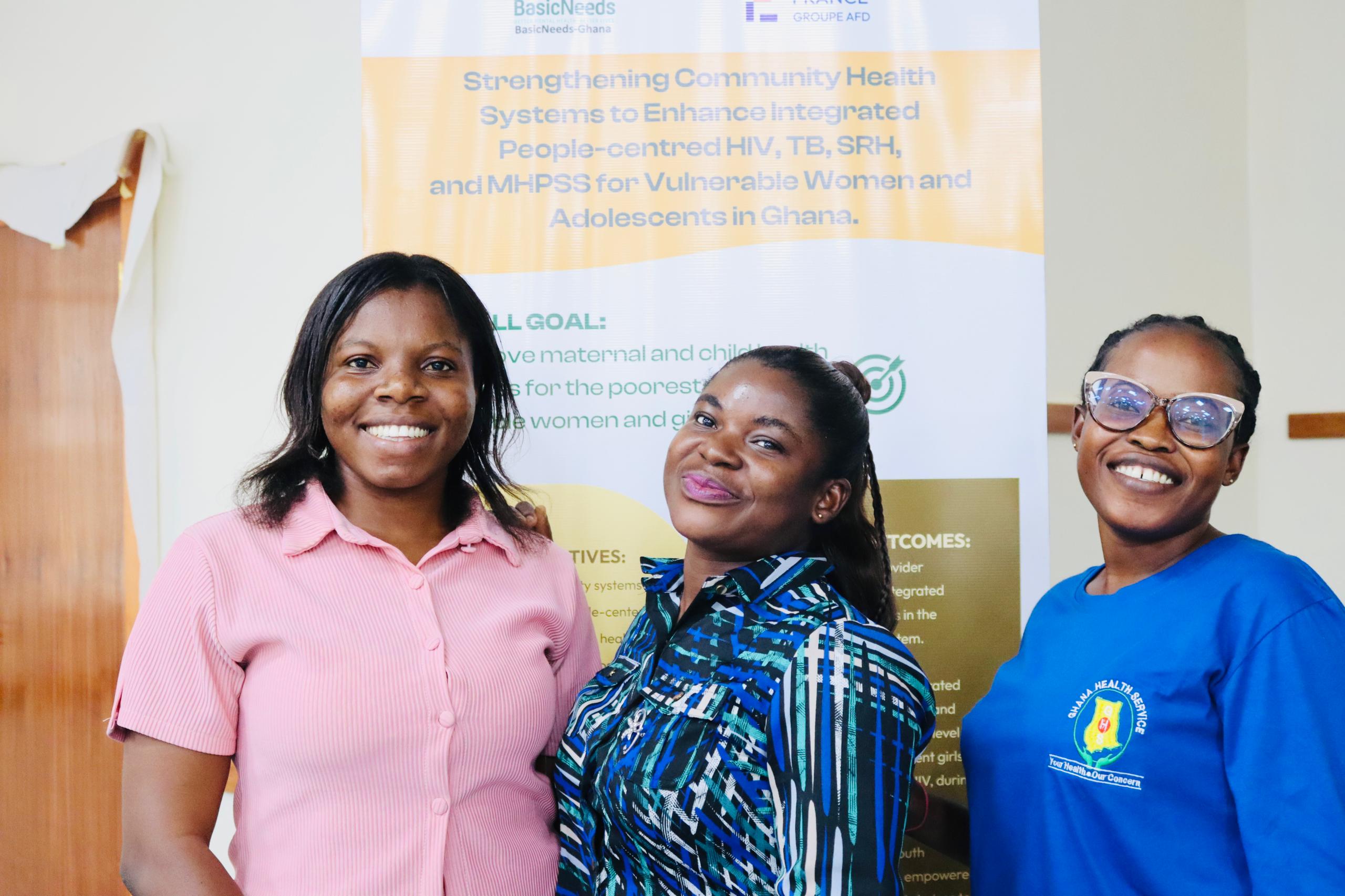
Specific goal: to improve maternal and child health outcomes for the poorest and most vulnerable women in Ghana.
Expected results
- Result 1: District and community healthcare facilities have integrated MHPSS in their HIV, TB and MCH services, enhancing access to and quality of services, and health and wellbeing overall.
- Result 2: Perinatal and postpartum women and adolescent girls (15–49 years), 50% of whom will be living with HIV, have enhanced health and wellbeing as a result of accessing HIV/TB/MHPSS and perinatal and postpartum care services at the community level.
- Result 3: Women, girls and youth are empowered and making informed choices to protect their health and rights.
Key activities
- Train, support and supervise community healthcare workers to use screening tools to identify the MHPSS care needs of pregnant women, girls and postpartum mothers, including those living with HIV/TB.
- Create safe spaces for MHPSS and counselling support for target beneficiaries.
- Stratify treatment and care, and support outreach clinics.
- Undertake prevention and promotion activities and engagements to enhance mental health and wellbeing.
- Promote and support the provision of peer psychosocial support for HIV/TB-positive pregnant women, girls and postpartum mothers.
- Carry out a print and electronic media-based campaign.
- Establish 28 self-help peer adherence support groups to promote HIV/TB MHPSS treatment among pregnant women, girls and postpartum mothers.
- Engage and collaborate with government and state stakeholders to advance social protection, gender equality and women’s empowerment.
Target locations
14 MMDAs in 7 regions, covering 28 communities: Tamale Metropolitan and Gushiegu District (Northern Region); West Mamprusi Municipal and Mamprugu-Moaduri (North East Region); West Gonja Municipal and Central Gonja (Savannah Region); Bolgatanga Municipal and Talensi District (Upper East Region); Lawra Municipal and Daffiam-Busie-Issah District (Upper West Region); Sunyani Municipal and Sunyani East (Bono Region); Ashaiman Municipal and Ga West Municipal (Greater Accra Region).
Targets
- 14 District Health Directorates, 14 district hospitals and 28 sub-district/community health facilities (CHPS)
- 21 doctors (9 female) — general physicians, medical assistants, obstetricians and gynaecologists, and psychiatrists
- 1,400 community health workers (660 female) — midwives, nurses, community health nurses and CPNs/CMHOs
- 49 bio-statisticians (10 female)
- 14,000 pregnant women, girls and postpartum mothers (15–49 years)
- 800 infants and children (0–5 years) and 850 men, husbands and partners
- 250,000 members of the general public (15,000 female)
Progress
- Project protocol ethics committee review approval granted by the Ghana Health Service.
- Implementation partnership agreements, collaborative engagements and project inception meeting held.
- Project baseline completed.
- 1,390 community healthcare workers trained (867 female).
- Assessment of MHPSS provision in MCH clinics and VCT/TB units.
- IEC/SBCC materials being co-developed; stakeholder meeting held.
Funded by: Expertise France. Project partners: CPRI, CHAG and MEHSOG.