Current Projects

Hope Research Project targets needs of homeless people with severe mental illness

Around the world, studies show that individuals with Severe Mental Illness (SMI) are disproportionately represented among homeless populations- Barry et al. (2024) in JAMA Psychiatry). In Addis Ababa,…
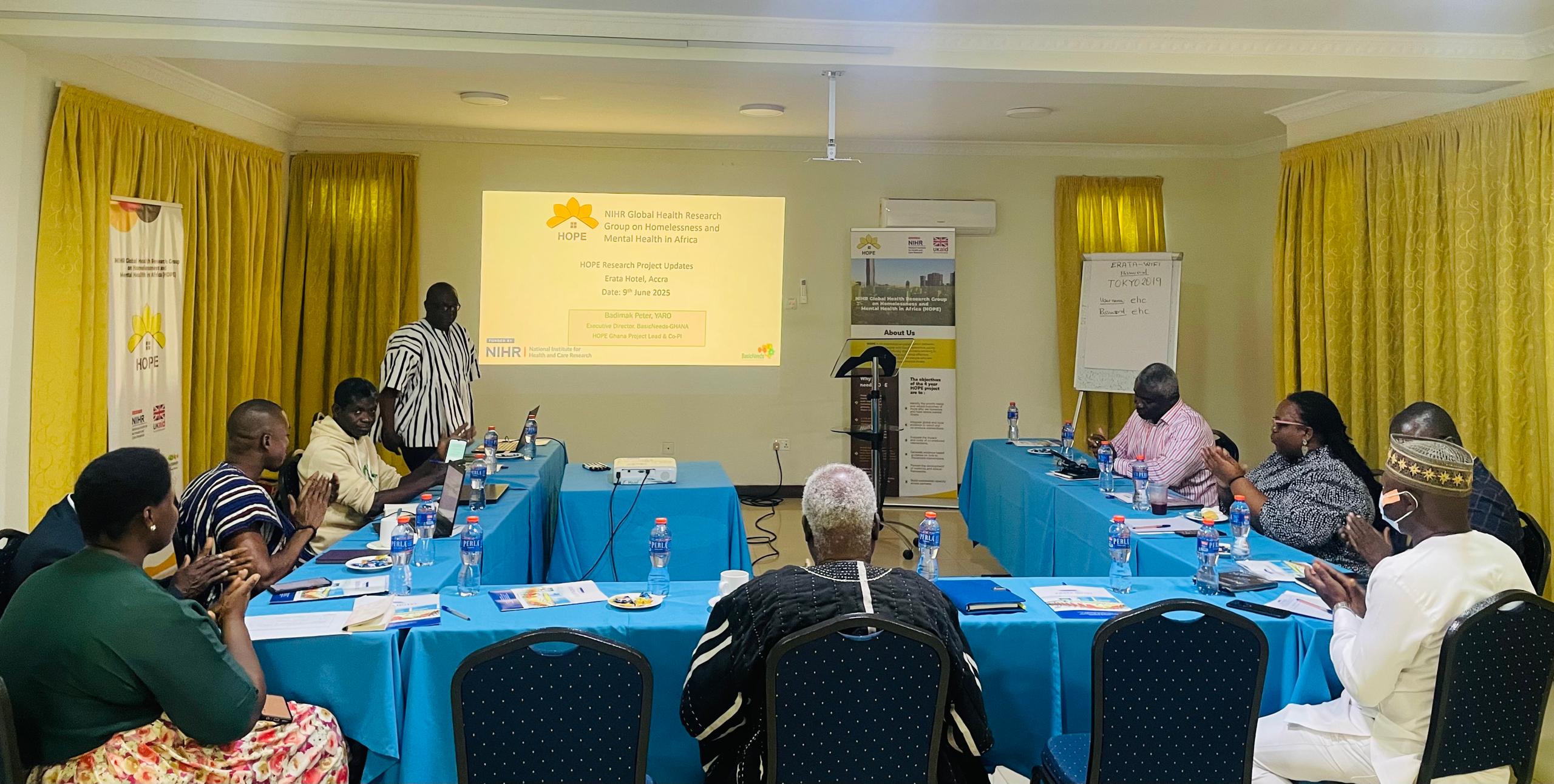
HOPE Country Management Group presentation

Funded by

UK National Institute for Health and Care Research (NIHR134325)

About the Project

Around the world, studies show that individuals with Severe Mental Illness (SMI) are disproportionately represented among homeless populations- Barry et al. (2024) in JAMA Psychiatry). In Addis Ababa, Ethiopia, for instance, two in five homeless people were found to be living with SMI. The unmet needs of individuals with Severe Mental Illness are wide-ranging; spanning human rights protections, access to shelter, food, sanitation, health care, safety, social reintegration, and economic recovery.
To address these gaps, the “Improving outcomes for people who are homeless and have severe mental illness in Africa” HOPE Project, a four-year research initiative, is investigating the realities of homeless persons with SMI. Funded by the UK’s National Institute for Health and Care Research (NIHR), the project is being implemented in Ghana, Ethiopia, and Kenya to design context-specific approaches that improve the lives of people living with both conditions.
The HOPE Project brings together researchers, policymakers, community members, and people with lived experience of SMI and homelessness. The project focuses on addressing unmet needs in Low- and Middle-Income Countries (LMICs) through approaches that are rights-based, contextually relevant, and scalable.

The project’s objectives include:

  • Identify priority needs, valued outcomes, and intervention opportunities/challenges for
    homeless persons with SMI
  • Integrate global and local evidence to co-produce and pilot interventions for feasibility
    and acceptability
  • Evaluate intervention impact on human rights, outcomes, costs, and implementation
    processes.
  • Develop methods and ethical frameworks for research with homeless persons with SMI.

PROGRESS IN GHANA
In Ghana, the project has mapped homeless populations in Tamale, profiled 72 individuals with SMI, and conducted ethnographic studies, interviews, and focus group discussions. Training workshops have been organised to equip people with lived experience with skills in advocacy, research participation, and storytelling. The Country Management Group (CMG) and the Community Advisory Board (CAB) are two key structures that have been established to guide and strengthen the project’s implementation. The CAB includes five people with lived experience of mental illness alongside HOPE project team members. These platforms bring together stakeholders, service users, and community representatives to ensure research findings translate into meaningful policy and interventions. Ghana has also participated in systematic peer reviews and grey literature reviews to examine evidence on the effectiveness, feasibility, and acceptability of interventions for homeless people with SMI in LMICs.

Ghana is currently working on a participatory intervention plan, structured in three phases:

  •  Outreach, Initial Identification, Assessment and Triage
  •  Stabilization
  • Care Pathways and Linkage

So far, Ghana has contributed to three international scientific conferences under the HOPE Project:

  • 2023 – Addis Ababa
  • 2024 – Nairobi
  • 2025 – Accra

The project involves a wide network of collaborators, including King’s College London, University of Nottingham, University of Warwick, Addis Ababa University, BasicNeeds-Ghana, and University Mental Health Research Foundation in Kenya, George Washington University (USA), and CMB-Global.


About the HOPE research group

HOPE is the NIHR Global Health Research Group on Homelessness and Mental Health in Africa (NIHR134325). The research is funded by the National Institute for Health and Care Research (NIHR) using UK international development funding from the UK Government to support global health research.

The research moves through three phases — formative (months 3–15), develop and pilot (months 16–24), and implement and evaluate (months 24–42) — with capacity strengthening for people with lived experience, multisectoral stakeholders and researchers. Its intended impact is improved health and wellbeing of homeless persons with severe mental illness, manualised open-source interventions and a WHO ‘how to’ manual.

Other project collaborators include the Ghana Health Service, Tamale Metropolitan Assembly and the Ghana Mental Health Authority.

Progress so far

  • Research ethics approval secured from GHS-ERC and King’s College London
  • Lived Experience Advisory Group (LEAG) formed and operating; Country Management Group (CMG) established
  • Doctoral student / PhD fellow; research Theory of Change developed and refined periodically
  • Annual scientific general meetings held in Addis Ababa, Nairobi and Accra
  • Formative phase completed (mapping local resources; focused ethnographic study) — manuscripts being developed
  • Cross-sectional survey: 28 field data collection officers recruited and trained, surveying 741 respondents
  • Co-production, piloting and evaluation of an intervention: a three-phase intervention and working group planning completed

Support Our Projects

Your support helps us reach more people and create lasting change in communities across Ghana.

Related Projects

Explore More Projects

Promoting Climate Resilient Organic Vegetable farming and small ruminants rearing among persons with mental health conditions and their primary caregivers and vulnerable widows in Northern Ghana

Promoting Climate Resilient Organic Vegetable farming and small ruminants rearing among persons with mental health conditions and their primary caregivers and vulnerable widows in Northern Ghana

This is an eighteen-month (August 2023 – July 2025) project, funded by the UNDP Adaptation Fund Climate Innovation Accelerator (UNDP-AFCIA) supporting dry season vegetable gardening ...
View Project
Ghana Risperdal Access Initiative

Ghana Risperdal Access Initiative

Through the support of JANSSEN (Johnson & Johnson Ltd) Direct Relief, a United States of America (USA) based medical charity provides donations of risperidone and ...
View Project
AZANSI Family Programme

AZANSI Family Programme

The ANZANSI Family Programme is an intervention research funded by National Institute of Mental Health (NIMH) of the United States of America (USA) National Institutes ...
View Project

Stronger Together

Together for Stronger, More Resilient Communities

Explore all our projects and see how we’re building a more inclusive and hopeful Ghana.

Scroll to Top